
SingularityNET-Linked Credential Abuse Drains 8.72M FET, Mints 408.5M NTX
Key Facts
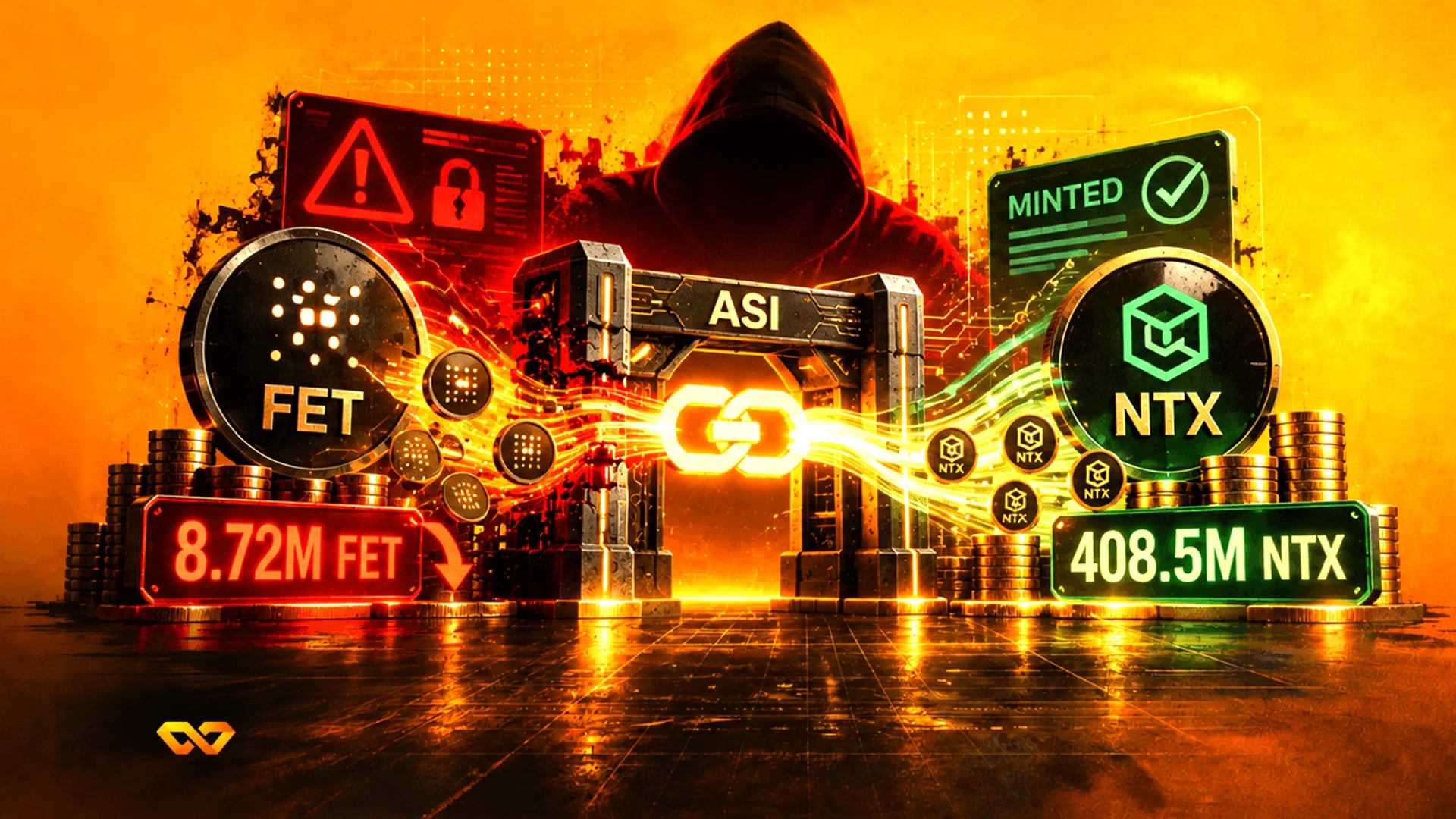
On-chain analysis shows that credentials linked to the SingularityNET stack were used on September 19 and 20, 2026. A conversion contract lost 8.72 million FET, after which 408.5 million NTX was minted directly through the token's minting privilege; later transactions created about 896 million AGIX, 500.5 million WMTX and 492.4 million CGV, according to Bitquery.
The $16.77 million figure was not a realized cash loss; it valued tokens in one wallet at prices recorded before liquidity in some of them collapsed. Bitquery estimated proceeds at about $2.25 million, comprising 522.78 ETH from the FET sale and another 183.96 ETH plus $52,395 in stablecoins from later activity.
SingularityNET bridges burn tokens on the source network and mint an equal amount on the destination network. The contract relies on an authorized signature as proof of the burn, so control of the accepted key can produce an approval without a matching burn; NTX, by contrast, was minted directly from its token contract. The transactions point to an authorization-layer failure rather than a failure of Ethereum or Cardano, although how the keys were obtained remains unresolved.
NuNet documentation sets total supply at 1 billion NTX, while Bitquery measured about 1.408 billion after the addition of 408.5 million unauthorized NTX, equal to 29.0% of observed supply. New minting dilutes existing units and increases the supply competing for the same liquidity; draining existing FET from a converter creates no new units.
Fetch.ai paused AGIX-to-FET conversions on September 20, 2026 and said its contracts were not at risk, with SingularityNET infrastructure targeted. The final loss and supply impact remain provisional because the published analysis is preliminary and final technical findings have not been released.
Latest Updates · 2
- Notable·
Update: Further investigations revealed that the attacker drained 8.7 million FET tokens and illicitly minted 2.3 billion tokens across three ASI alliance bridges. This maneuver allowed the exploiter to realize approximately $1.9 million in gains, highlighting the specific vulnerability within the cross-project bridge infrastructure.
- Notable·
Update: Fetch.ai has preemptively halted AGIX-to-FET token conversions following the drainage of approximately $1.56 million in FET tokens. According to reports, the attacker exploited the TokenConversionManagerV3 contract, prompting the project to pause bridge operations to mitigate further financial impact.