
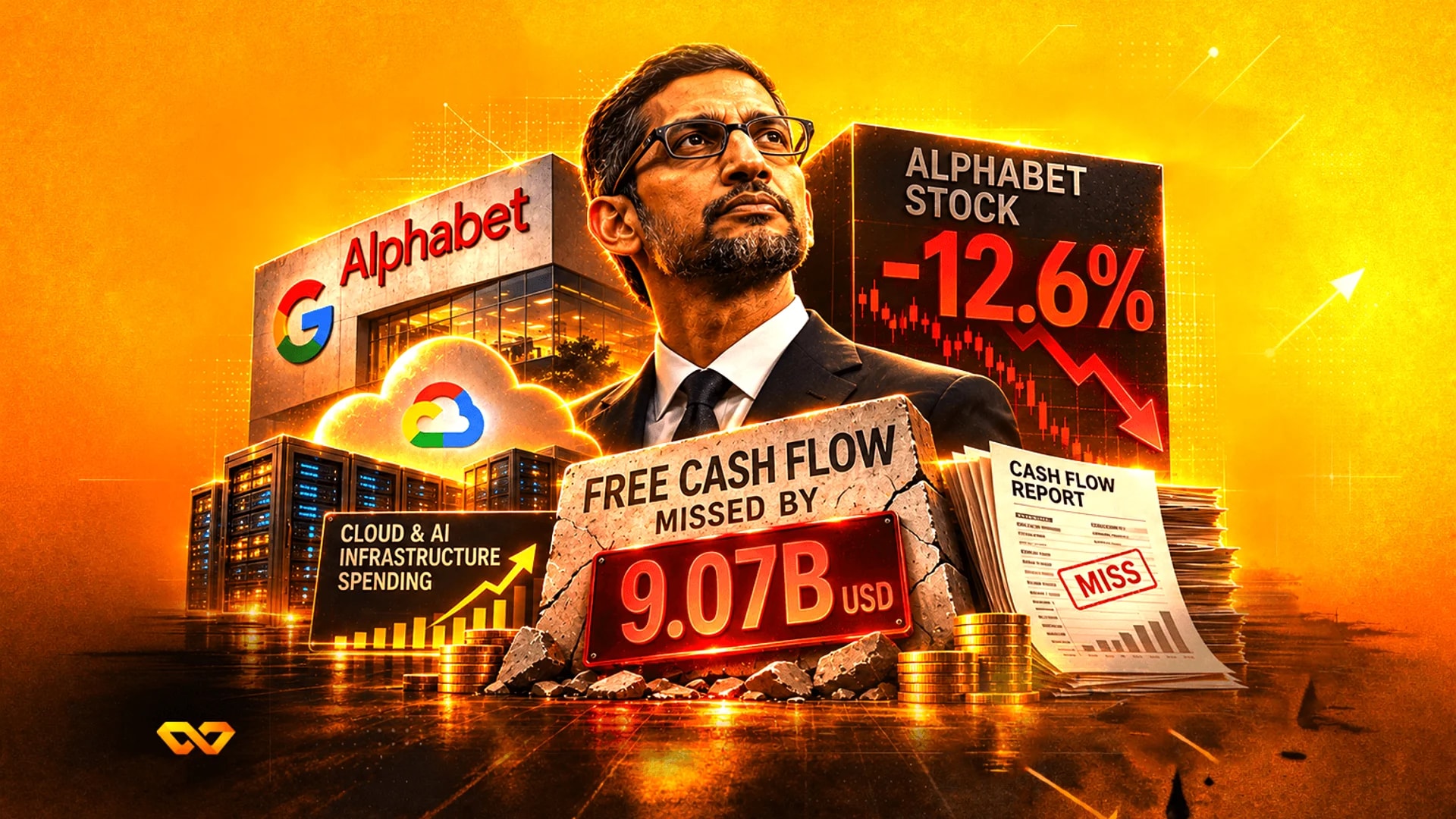
Alphabet shares fall 12.6% as free cash flow misses by $9.07 billion
Key Facts
Alphabet Class A shares fell 12.6% on October 29, marking their worst session since trading began more than 20 years ago, after third-quarter results revealed a free cash flow deficit and a decline in net income. GOOGL shares closed at $283.82, compared with $324.89 in the previous session, according to EL7 data. Revenue rose 25% year over year to $127.58 billion, but came in below the FactSet average estimate of $127.97 billion, the Associated Press reported. The company also posted net income of $26.17 billion for July through September, down from $34.98 billion a year earlier. Before the session opened, the stock had fallen more than 10% to $289.95 in extended trading after the results announcement, according to the Associated Press.
Earnings per share came to $2.12, below analysts’ estimate of about $3.01, though part of the gap was tied to losses on equity investments. The Associated Press said those losses totaled $8.7 billion and reduced earnings per share by 55 cents. That measure differs from the adjusted earnings reported by Reuters, so the two figures should not be conflated when reading the quarterly results. On revenue, Google advertising generated $82.01 billion, about $1.41 billion below expectations, according to Reuters. The news agency attributed the overall revenue miss to weakness in core advertising activity, despite cloud revenue exceeding market estimates.
Search remained the largest advertising segment, with Google Search and other revenue rising 12% to $63.3 billion in the third quarter, while YouTube advertising increased 9% to $11.2 billion, according to the Associated Press. Still, search and advertising results came in below some analysts’ expectations, and Reuters attributed part of the slowdown in search advertising growth to increased use of the AI Mode interface. Google’s business chief said, in comments cited by Reuters, that the company was still testing ads within the interface and would begin rolling them out in international markets. A portfolio manager told the news agency that investors wanted to see search accelerate, not slow, amid concerns that artificial intelligence could undermine core search activity. Testing ads in the new interface puts monetizing usage among the commercial challenges accompanying the growth of AI products.
By contrast, Google Cloud revenue rose to $30.71 billion, more than doubling from the year-earlier period and exceeding estimates, according to Reuters. Unit chief Thomas Kurian said sales of TPU chips had become a significant contributor to the cloud business. Google Cloud’s backlog stood at about $561 billion, and the company expects to recognize more than 55% of it as revenue over the next 24 months. But the business expansion coincided with increased spending on data centers and equipment; purchases of property and equipment exceeded $51 billion in the quarter, according to the Associated Press. That spending, along with building inventory of TPU systems to meet demand, weighed on cash before customer payments were collected, Reuters said.
Free cash flow was negative $9.07 billion, against expectations that it would approach breakeven, according to Reuters. The deficit widened from $5.9 billion in the previous quarter, marking a second consecutive quarter of negative cash flow and the first such shift in the company’s 22-year history as a public company, the news agency reported. Reuters described the shift as a departure from Alphabet’s long record as one of the technology sector’s leading cash generators. An investment official said the heavy cash burn and rising capital spending raised questions about whether AI returns could “justify the expense.” After the stock fell 12.6% on Thursday, its losses extended into Friday’s session, according to Reuters.
In the broader market, the S&P 500 fell 0.3% on October 29, its first loss in four days, while the Nasdaq Composite dropped 1.4%, according to the Associated Press. Still, four out of every five stocks in the S&P 500 rose, and the news agency said the index would have closed higher but for Alphabet’s decline. The session thus showed how significantly the stock’s fall affected the index reading, despite gains across most of its constituents. Alphabet’s decline followed results that combined strong cloud growth with a revenue miss and a widening cash deficit. It also coincided with investor questions about the spending required to expand AI infrastructure and the returns it would generate.
The chief financial officer said the 2026 capital spending forecast remained between $195 billion and $205 billion, and that it would increase significantly in 2027, without giving a figure for next year, according to Reuters. She added that the use of third-party cloud capacity would weigh on margins in the near term. The company is scheduled to provide more details on the spending increase during its fourth-quarter earnings call, according to the Associated Press. For Google Cloud, Kurian expected TPU system sales to rise in the current quarter and accelerate significantly in 2027, Reuters reported. At the same time, Google services revenue in the fourth quarter is expected to face a comparison with the acceleration in search that began in the third quarter of the previous year, according to company guidance included in the first draft.