
Dollar Index at 101.72 as Australia Raises Rates 25 Basis Points to 4.85%
Key Facts
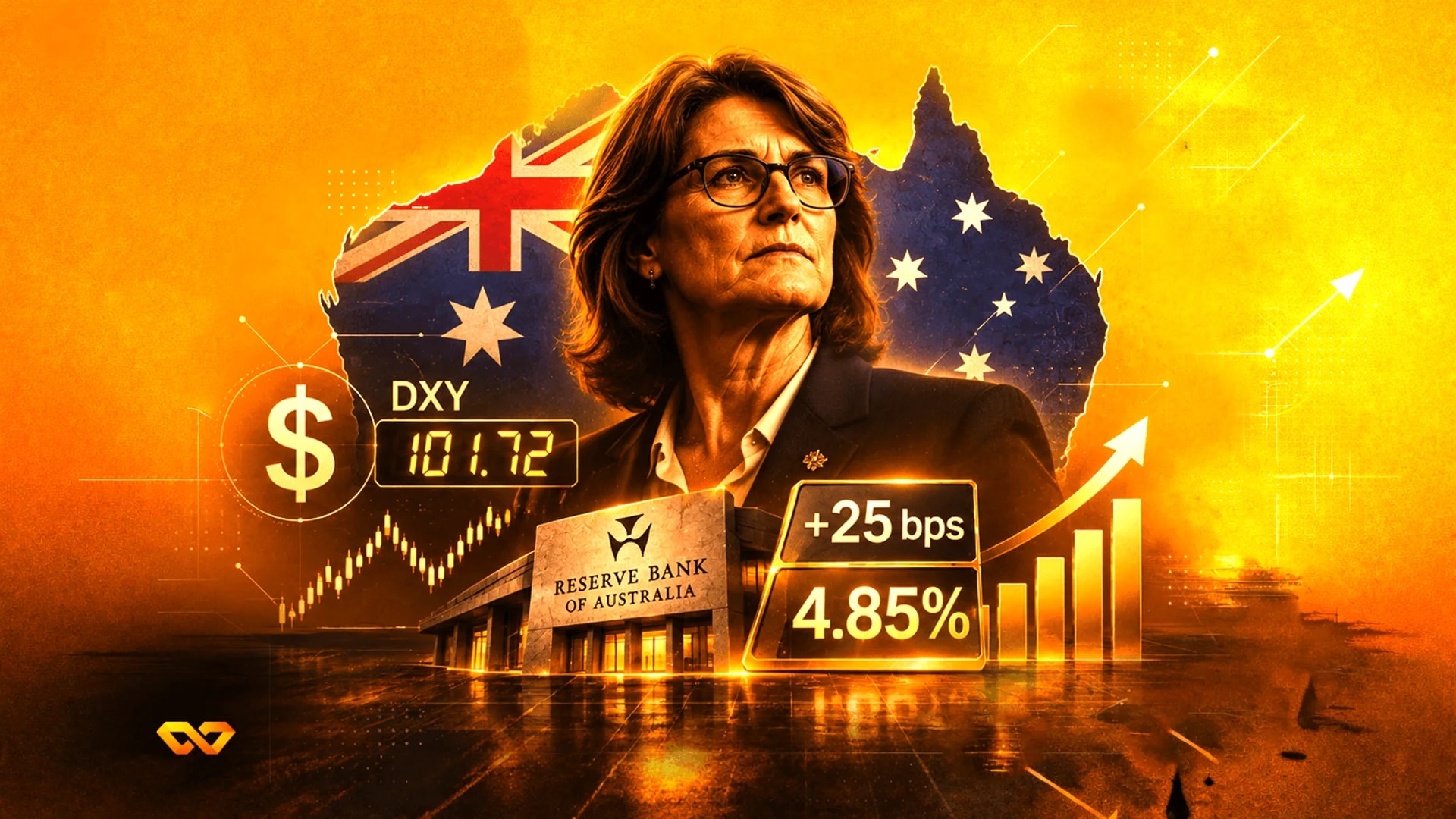
The Reserve Bank of Australia raised its cash rate by 25 basis points to 4.85% at its November 3, 2026 meeting, keeping inflationary pressures at the forefront of monetary policy. The decision came as the Dollar Index traded at 101.72 points, after falling to a one-month low in the previous session, according to Reuters. The bank’s board approved the increase by 6 votes to 3, in a split Reuters described as unexpectedly narrow. The bank said in a statement that the board had decided to "increase the cash rate target by 25 basis points to 4.85%." Australia’s rate increases during 2026 totaled 125 basis points across five moves, Reuters reported.
The rate increase was not followed by a rise in the Australian currency; the Australian dollar fell as much as 0.35% to $0.6973 after the decision. Reuters said the narrow vote could indicate policymakers were nearing the end of their tightening campaign, an inference from the market’s reading of the vote rather than an official statement by the bank. The currency’s move reflected investors’ response to the decision and its signals about the subsequent path of monetary policy. In the broader currency market, the euro was at $1.1195 and sterling at $1.3417, while the yen stood at 157.81 per dollar in readings Reuters reported on November 3. The Dollar Index closed at 101.735 points in EL7 data that day, compared with 101.67 points on November 2.
The Reserve Bank of Australia forecast headline inflation would peak at 4.5% in the December quarter of 2026 and remain above 3% until late 2027. It also forecast inflation would return to the midpoint of its 2–3% target range in mid-2028. For underlying inflation, the bank said it would remain above 3% until the end of 2027 before gradually declining to about 2.5% in mid-2028. The bank attributed its revised price outlook to higher fuel and other goods prices driven by the conflict in the Middle East. It added that persistent pressure on domestic capacity and rising inflation expectations had contributed to its forecast of continued price pressures.
On economic activity, Australian residential building approvals rose 5.1% in September to 17,948 units, according to the seasonally adjusted estimate from the Australian Bureau of Statistics. The increase followed a 5.2% decline in approvals in August, showing a monthly improvement in the September reading. In contrast, the bank raised its forecast for the unemployment rate to 5.1% by the end of 2028, about a quarter of a percentage point higher than its previous estimate. Its projections also assume GDP growth below estimates of potential growth over the coming years and an increase in the interest rate of about 35 basis points through mid-2027. Together, the forecasts point to continued high inflation alongside an expected relative weakening in the labor market and growth.
In global markets, Reuters said a stock market sell-off driven by concerns about artificial intelligence hurt risk sentiment and provided some support for the dollar. Investors also tracked U.S.-Iran tensions and the U.S. midterm elections, factors that added to market caution. The Dollar Index had fallen to a one-month low on Monday, November 2, before trading at 101.72 points the following day. In the United States, the September report recorded an increase of 29,000 in nonfarm payrolls, and the unemployment rate was 4.2%; the Bureau of Labor Statistics said both measures changed little. The reading provides labor market context ahead of the next report.
The next U.S. milestone on the Bureau of Labor Statistics’ calendar is November 6, when it is scheduled to release the October jobs report at 08:30 a.m. Eastern time. The report follows the September reading, which showed 29,000 nonfarm jobs added and an unemployment rate of 4.2%. Its release will provide a new reading on the U.S. labor market, which markets are monitoring alongside Australia’s rate decision. In Australia, the bank’s forecasts for inflation and unemployment through 2028 remain part of the backdrop for assessing monetary policy. The November decision raised rates to 4.85% amid a divided vote and a decline in the local currency after the announcement.