EL7 ResearchDebt Markets and Artificial Intelligence · 11 August 2026
Following the money: who pays the AI bill?
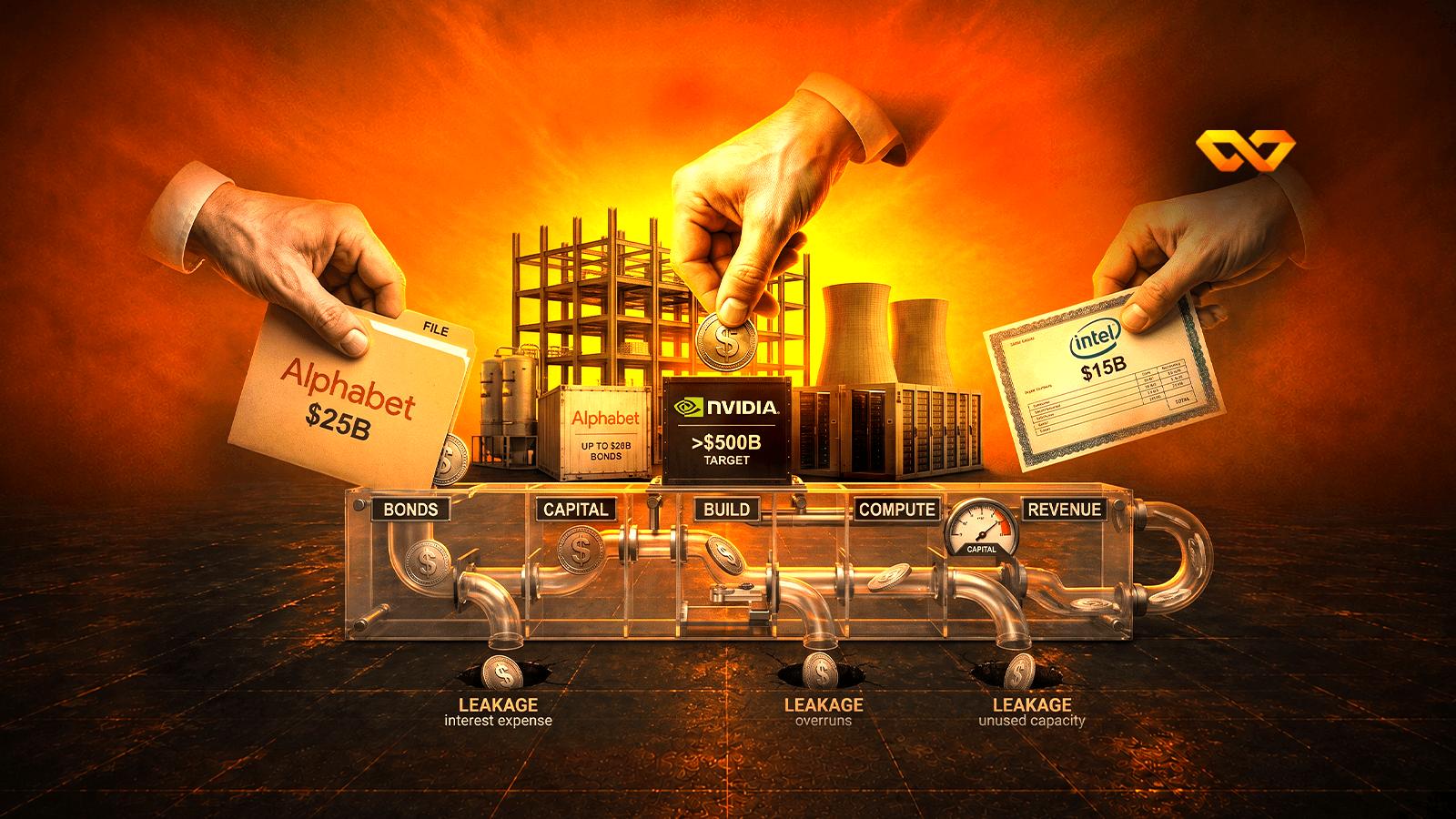
In one week: Alphabet borrows 25 billion dollars, Nvidia assembles a Wall Street alliance to mobilise 500 billion in external capital, and Intel sells 15 billion in shares. This report follows the dollar: from the bond desk, to the construction site, to the circular loop through which it returns to the pocket of its spender — and to the holes through which it leaks.
Executive summary
The financial model for the boom has changed fundamentally: Alphabet — which self-funded since 2004 — posted the first negative free cash flow in its history and borrowed 25 billion dollars against orders totalling ~115 billion; the three largest order books in the history of US corporate bonds have all emerged in the past six months, all to finance AI.
The bill: spending by the Big Four alone is heading towards ~725 billion dollars in 2026 (+77% versus 2025), while models place the 2027 total above one trillion dollars.
The source of funding is moving outside the sector: AI-linked debt is heading towards ~570 billion dollars this year — and yesterday Nvidia announced a partnership with Apollo, Blackstone, BlackRock, Brookfield, Goldman Sachs and KKR to mobilise +500 billion dollars of “third-party capital” through independent computing-finance platforms, sending its shares lower and wiping ~130 billion from its value in the session.
The top watchdog is concerned: the Bank for International Settlements made the sustainability of AI investment and circular financing (~800 billion dollars in intertwined arrangements) among the leading risks to the financial system in its annual report, citing a projection that places the aggregate free cash flow of the largest builders at zero by Q3 2026.
The conclusion: a genuine boom financed with bubble instruments — and the weak point has shifted from the equity market to the credit market. The first warning bell will not appear in share prices, but in the bond yield spreads of the builders and the first cut to spending guidance.